
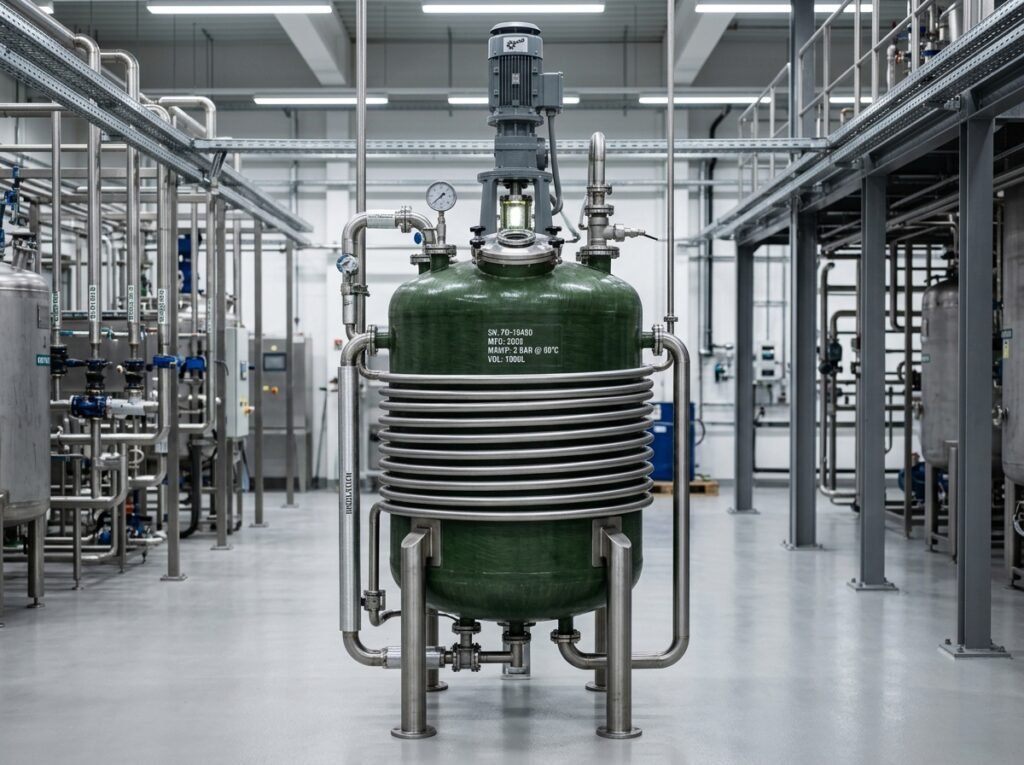
The Double Challenge of Abrasion & Corrosion in Dye Manufacturing
India is a global powerhouse for reactive dyes, disperse dyes, and organic pigment manufacturing, centered heavily in Gujarat industrial estates such as Vapi, Ankleshwar, and Panoli. These plants handle dense, crystalline, abrasive chemical slurries (such as Phthalocyanine Blue/Green, CPC crude, and beta-naphthol derivatives) suspended in strong sulfuric acid, hydrochloric acid, or caustic soda.
Standard storage tanks fail rapidly under these conditions because the continuous churning of high-solids slurries physically scours the tank walls and agitator blades, accelerating chemical pitting—a mechanism known as erosion-corrosion.
1. Formulating Abrasion-Resistant FRP Composites
Nikunj Fibre Glass incorporates specialized abrasive-wear technology into custom FRP tanks and agitator impellers:
- Silicon Carbide (SiC) & Ceramic Infusion: Adding fine silicon carbide or alumina ceramic micro-particulates into the resin corrosion barrier dramatically elevates scratch and abrasion resistance (Taber abrasion loss reduced by over 60%).
- Synthetic Polyester Surfacing Veils: Replacing traditional glass C-veils with heavy synthetic polyester veils (such as Nexus veil) provides outstanding toughness against particulate impingement.
- Encapsulated FRP Agitators: Solid steel agitator shafts and hydrofoil hydro-blades are encapsulated with a 5mm to 8mm seamless vinyl ester composite laminate, preventing acid attack on the drive core.
2. Tank Geometry Optimization for Slurry Agitation
To prevent solid settling and dead zones, tanks are designed with conical or dished bottoms with center bottom drainage nozzles. Internal baffles and nozzle neck entries are radius-blended to eliminate sharp stagnation edges where slurry can cake and solidify.
Explore Nikunj Chemical Processing Vessels
View our complete line of FRP Chemical Storage Tanks engineered for heavy industrial slurries.