
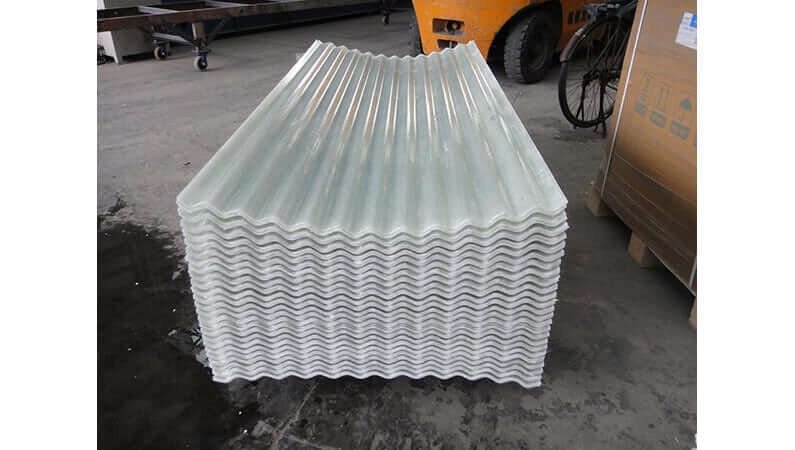
The Challenge of Industrial Roofing in Aggressive Atmospheres
Industrial manufacturing plants involved in acid pickling, chlor-alkali production, electroplating, chemical synthesis, and fertilizer blending experience heavy emissions of sulfur dioxide (SO2), hydrogen chloride (HCl), ammonia (NH3), and moisture. Under these corrosive conditions, conventional galvanized iron (GI), asbestos, or pre-painted galvalume metal sheets corrode and perforate within just 2 to 3 years.
Fiberglass Reinforced Plastic (FRP) corrugated and profile roofing sheets engineered by Nikunj Fibre Glass offer the ultimate non-metallic solution for corrosive industrial sheds and PEB structures.
1. Why FRP Outperforms Metal Roofing Sheets
- Total Chemical Immunity: FRP polymer sheets do not oxidize, pit, or react with acidic or alkaline vapors rising from open processing vats and reactors.
- High Strength-to-Weight Ratio: Reinforced with multi-axial woven roving and chopped strand mat (CSM), FRP sheets withstand high gust wind loads while adding minimal dead load to structural PEB purlins.
- Superior Thermal Insulation: FRP has significantly lower thermal conductivity than corrugated steel, reducing heat transmission into the plant floor during intense summer heat.
- Diffused Daylighting: Translucent FRP profile sheets provide up to 75% natural daylight transmission, drastically reducing industrial lighting energy costs while blocking harmful UV rays.
2. Profiles and Technical Specifications
| Property | Specification / Value |
|---|---|
| Resin Matrix | UV-Stabilized Isophthalic Polyester / Vinyl Ester |
| Glass Content | 30% to 35% by weight |
| Tensile Strength | 90 – 110 MPa (ASTM D638) |
| Profiles Available | Trapezoidal (Box Profile), Corrugated (Sinusoidal), Custom PEB Match |
| Surface Protection | Anti-aging UV surface film (Melinex 301 / DuPont Tedlar) |
Explore Nikunj Industrial Roofing Solutions
View our FRP Corrugated Roofing Sheets and industrial wall cladding options.