
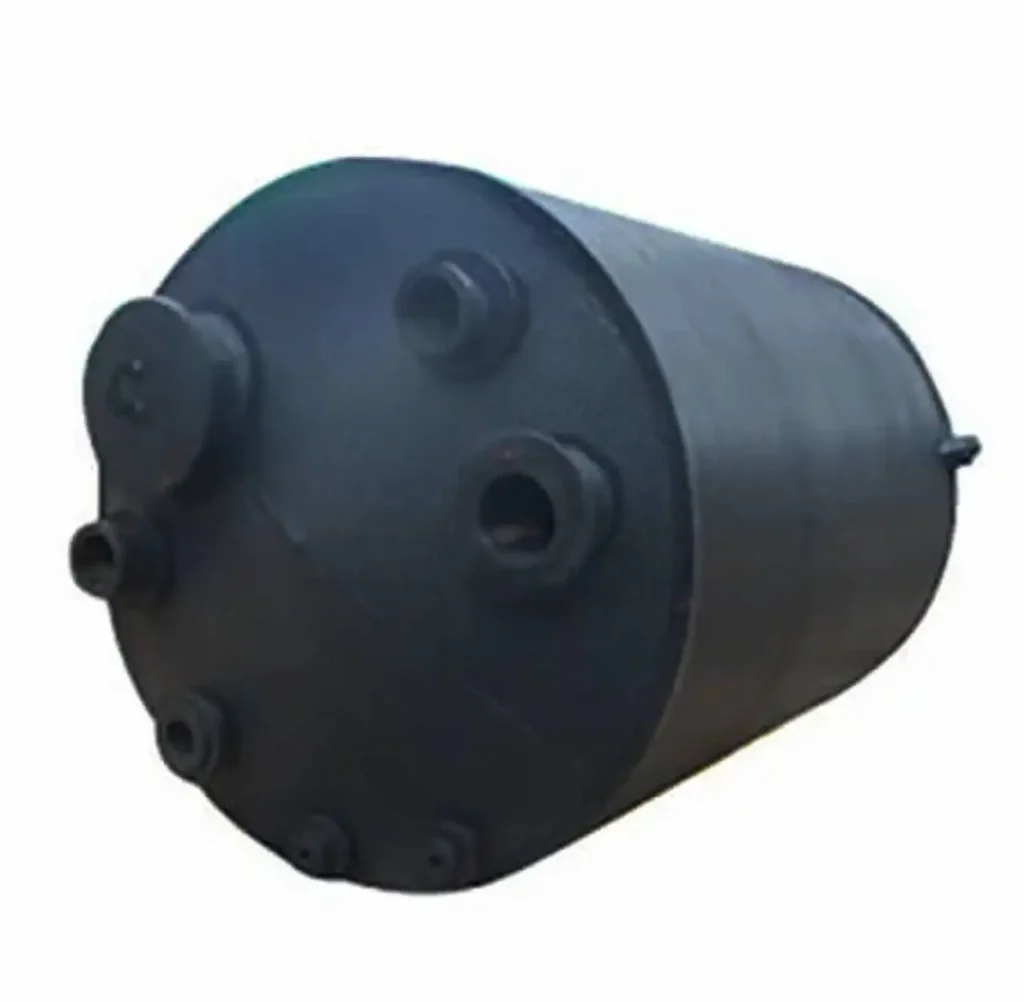
Choosing the Right Orientation for Industrial Chemical Storage
When planning bulk chemical storage or dosing facilities, process engineers must decide between vertical cylindrical tanks and horizontal cylindrical tanks. The correct orientation impacts plant footprint, structural foundation costs, liquid discharge efficiency, and seismic resistance.
1. Technical Comparison: Horizontal vs. Vertical FRP Tanks
| Design Criterion | Vertical FRP Cylindrical Tank | Horizontal FRP Cylindrical Tank |
|---|---|---|
| Plant Footprint | Minimal floor space; expands vertically | Larger floor footprint required |
| Height & Headroom | Requires substantial ceiling clearance outdoors or in high-bay sheds | Ideal for basements, low-ceiling sheds, or elevated platforms |
| Hydrostatic Pressure | High bottom hydrostatic head; requires graded bottom shell wall thickness | Lower hydrostatic head across long diameter |
| Complete Drainage | Excellent complete drainage with sloped, dished, or conical bottoms | Requires bottom sump or sloped installation on saddles |
| Structural Supports | Flat bottom plinth or skirt / leg supports | Rigid FRP or epoxy-coated MS saddle supports with elastomeric pads |
| Agitation & Mixing | Superior hydrodynamic flow patterns for top-mounted agitators | Difficult to achieve uniform agitation without dead zones |
2. Saddle Design for Horizontal FRP Tanks
Horizontal tanks require specialized saddle engineering under BS 4994 / ASME RTP-1 guidelines. The saddles must provide a minimum 120° to 150° contact angle around the lower circumference. Rubber or neoprene wear plates must be placed between the FRP shell and saddles to prevent localized shear stresses.
Custom Tank Fabrication at Nikunj Fibre Glass
Learn more about our custom FRP Chemical Storage Tanks engineered to BS 4994 and ASTM D3299 standards.