
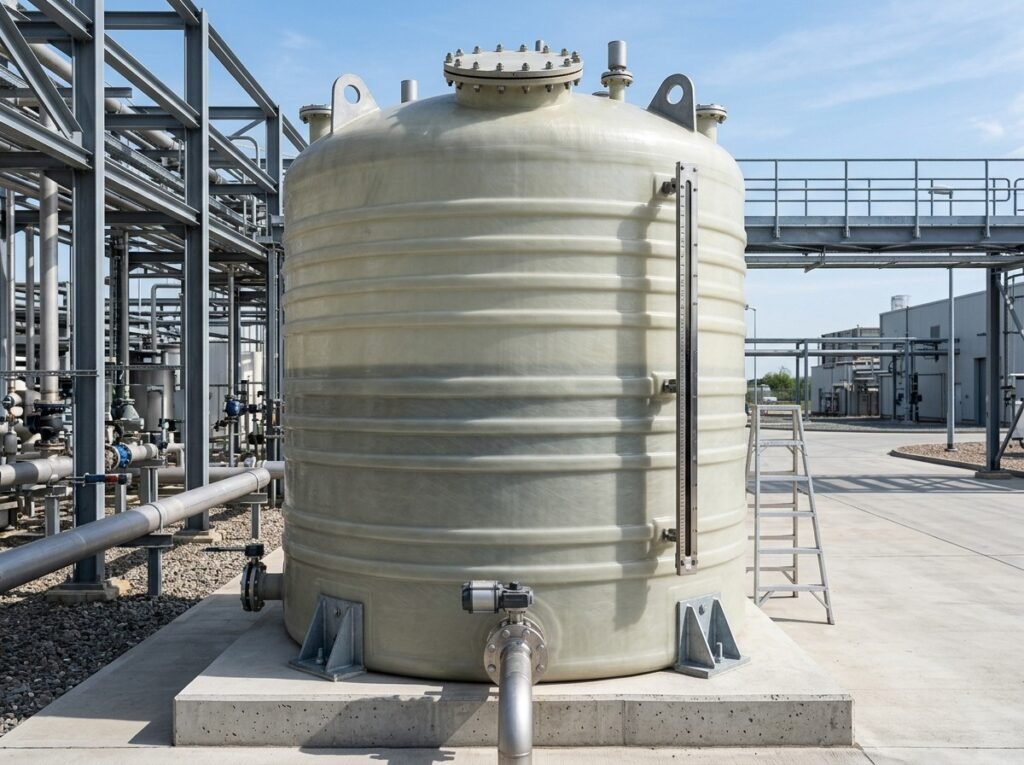
The Hidden Total Cost of Ownership in Chemical Storage
When procuring bulk chemical tanks for hydrochloric acid (HCl), sulfuric acid, or brine, procurement departments frequently compare only the initial Purchase Order (Capex) cost. Under Capex metrics, Rubber Lined Mild Steel (RLMS) occasionally appears comparable to or slightly cheaper than engineered Fiberglass Reinforced Plastic (FRP). However, evaluating the 20-year Total Cost of Ownership (TCO) reveals a radically different economic reality.
1. 20-Year Lifecycle Economic Comparison
| Cost Element | FRP Composite Tank (Nikunj Fibre Glass) | Rubber Lined Mild Steel (RLMS) Tank |
|---|---|---|
| Initial Capital Cost (Capex) | Moderate initial investment | Low to moderate initial cost |
| Expected Service Life | 20 to 30+ years without internal re-lining | 5 to 8 years before rubber lining failure / re-lining |
| External Maintenance & Painting | Zero painting needed; UV gelcoat lasts indefinitely | Repainting required every 2-3 years to stop rust |
| Lining Failure Risk | Monolithic structural corrosion barrier; cannot delaminate | Pinholes, blistering, and debonding cause hidden steel shell perforation |
| Internal Relining Downtime Cost | Zero relining downtime | Requires 3 to 4 weeks plant shutdown every 5-7 years for relining |
| Civil Foundation Cost | 25% of steel deadweight; lower civil foundation costs | Heavy steel vessel requires heavy RCC foundation plinth |
2. The Failure Mechanism of RLMS Tanks
In rubber-lined vessels, micro-pinholes or bond line failures allow aggressive acid to seep behind the elastomeric sheet. The acid corrodes the steel shell from within unseen by maintenance crews until catastrophic failure or acid breakthrough occurs. FRP composites are solid, homogeneous non-metallic structures with no bonded rubber interface to peel or blister.
Invest in Long-Term Plant Reliability
Discover our engineered FRP Chemical Storage Tanks engineered for maximum lifecycle ROI.