
Description
High-Performance PPR Pipes and Fittings
Nikunj Fibre Glass is a leading manufacturer and supplier of PPR Pipes and Fittings in Vapi, Gujarat. Since 1992, our facility has engineered dependable thermoplastic piping systems for industrial and commercial projects across India. Therefore, mechanical contractors, plumbing engineers, and chemical plant operators depend on our reliable piping solutions.
Polypropylene Random Copolymer (PPR / PPR-C Type 3) is globally celebrated for its exceptional thermal endurance and non-scaling surface. In addition, its mirror-smooth internal bore prevents pressure loss and calcification. Specifically, our PPR pipes and fittings handle hot and cold fluids up to 95°C with a service design life exceeding 50 years.
Comprehensive Range of Pipes & Fusion Fittings
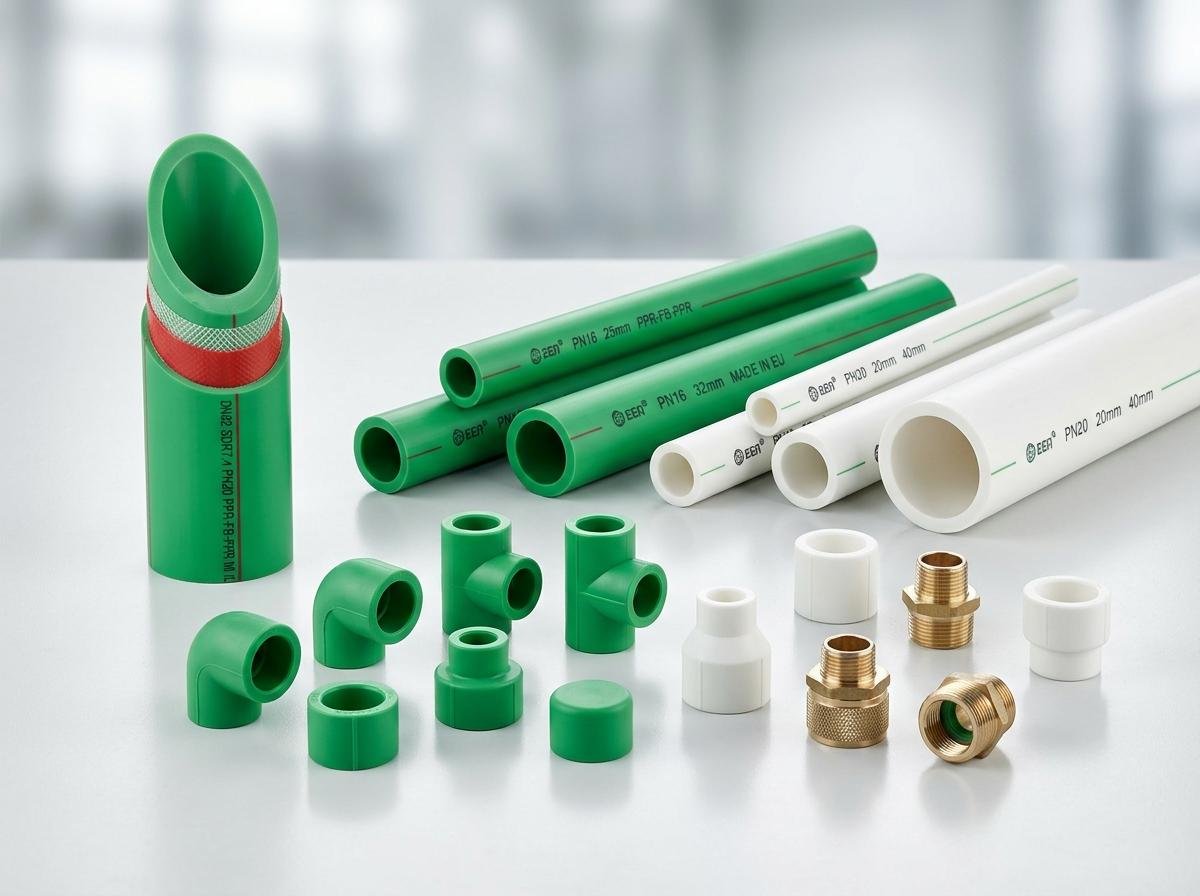
We supply complete PPR piping networks from 20 mm up to 160 mm in PN10, PN16, and PN20 pressure classes. For example, our fitting catalog includes couplers, 90-degree elbows, 45-degree elbows, equal and reducing tees, brass-threaded transition male/female adaptors, unions, and flanged adaptors. Consequently, installers execute complete leak-proof installations with seamless compatibility.
Key Advantages of PPR Pipes & Fittings
Durability, Cleanliness & Energy Efficiency
- Outstanding Thermal Resistance: Engineered for continuous operation at 70°C and peak temperatures up to 95°C. Therefore, it is ideal for industrial hot water, boiler feed, and solar heating lines.
- Zero Scaling & Mirror-Smooth Bore: The non-polar copolymer structure eliminates limescale deposits, algae growth, and bacterial accumulation. Thus, water purity remains uncompromised.
- Thermal Insulation & Low Noise: PPR features very low thermal conductivity (0.24 W/mK), minimizing heat loss in hot water lines without extra lagging. In addition, it absorbs hydraulic water hammer noises.
- Homogenous Socket-Fusion Joints: Pipe and fitting fuse molecularly during heat socket welding to create a single homogenous plastic unit. Consequently, joints can never leak.
- Corrosion & Chemical Resilience: Completely immune to aggressive water chemistry, industrial salts, mild acids, and electrochemical corrosion that destroys copper and GI pipes.
Technical Specifications: PPR Pipes & Fittings
Standard Dimensions & Engineering Ratings
| Technical Parameter | Design Standard & Specification |
|---|---|
| Applicable Standards | DIN 8077, DIN 8078, EN ISO 15874, and IS 15801 |
| Raw Material | 100% Virgin Polypropylene Random Copolymer (PPR-C Type 3) |
| Size Range | 20 mm (1/2″) to 160 mm (6″) outer diameter |
| Pressure Ratings | PN10 (cold water), PN16 (general fluid), PN20 & PN25 (hot water) |
| Jointing Method | Socket Fusion Welding & High-Grade Nickel-Plated Brass Threaded Inserts |
| Working Temperature | -10°C to +95°C continuous service |
| Color Options | Standard Green, White, and Industrial Grey |
Industrial Applications of PPR Piping Systems
Versatile Fluid Handling Networks
- ✅ Hot & Cold Water Plumbing: Hotels, hospitals, industrial complexes, and residential townships.
- ✅ HVAC & Chilled Water Lines: Connecting central air conditioning, fan coil units, and cooling towers.
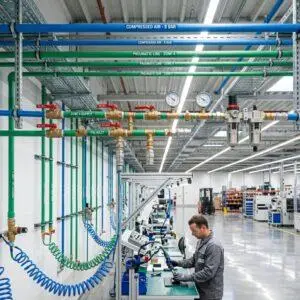
- ✅ Industrial Compressed Air: Leak-proof pneumatic piping systems with zero pipe rust and low pressure loss.
- ✅ Food & Beverage Processing: Non-toxic, hygienic conveyance of potable water, dairy, and liquid food products.
Leading PPR Pipes & Fittings Manufacturer in Gujarat
Expedited Delivery Across Industrial Hubs
Nikunj Fibre Glass manufactures and distributes premium PPR pipes and fittings from Vapi GIDC, Gujarat. In addition, our distribution network ensures rapid fulfillment across all key industrial centers:
- Ahmedabad & Sanand: Vatva GIDC, Naroda, Odhav, Kathwada, Changodar, and Sanand
- Vapi & South Gujarat: Vapi GIDC, Sarigam, Umbergaon, Valsad, and Gundlav
- Surat, Ankleshwar & Dahej: Sachin GIDC, Pandesara, Ankleshwar GIDC, and Dahej PCPIR
- Vadodara & Central Gujarat: Makarpura GIDC, Nandesari, Halol, Savli, and Karjan
- Saurashtra Hubs: Rajkot, Jamnagar, Bhavnagar, and Morbi
Additionally, we supply matching uPVC Industrial Pipes, PVC Pipe Fittings, and FRP Tanks. Therefore, contact Nikunj Fibre Glass today for competitive wholesale pricing and prompt dispatch.
Frequently Asked Questions (FAQ)
Common Technical Inquiries
Q1: How does PPR compare to CPVC pipes for hot water supply?
While CPVC uses solvent cement glued joints, PPR uses socket heat fusion that melts the pipe and fitting into a single jointless piece. This homogenous heat weld completely eliminates glued joint degradation over time. Furthermore, PPR provides higher impact toughness in low temperatures and superior resistance to chemical scaling.
Q2: How are PPR pipes joined during installation?
PPR pipes are connected using a compact electric socket fusion machine. Heating dies melt the outside of the pipe and the inside of the fitting for several seconds. When pushed together, the melted layers fuse permanently within seconds, creating a joint that matches the pressure rating of the pipe itself.
Q3: Does Nikunj Fibre Glass supply brass threaded transition fittings for PPR?
Yes, Nikunj Fibre Glass supplies a complete selection of brass threaded male and female adaptors, elbow adaptors, and union connectors with heavy-duty dezincification-resistant brass inserts. These allow seamless connection to standard metal valves, pumps, and sanitary fixtures.
Nitin B. Solanki (verified owner) –
Hot & cold water PPR piping installed with socket fusion welding. Joints fuse into a monolithic pipe with zero chance of leakage. Thermal insulation property reduces chilled water heat gain.