
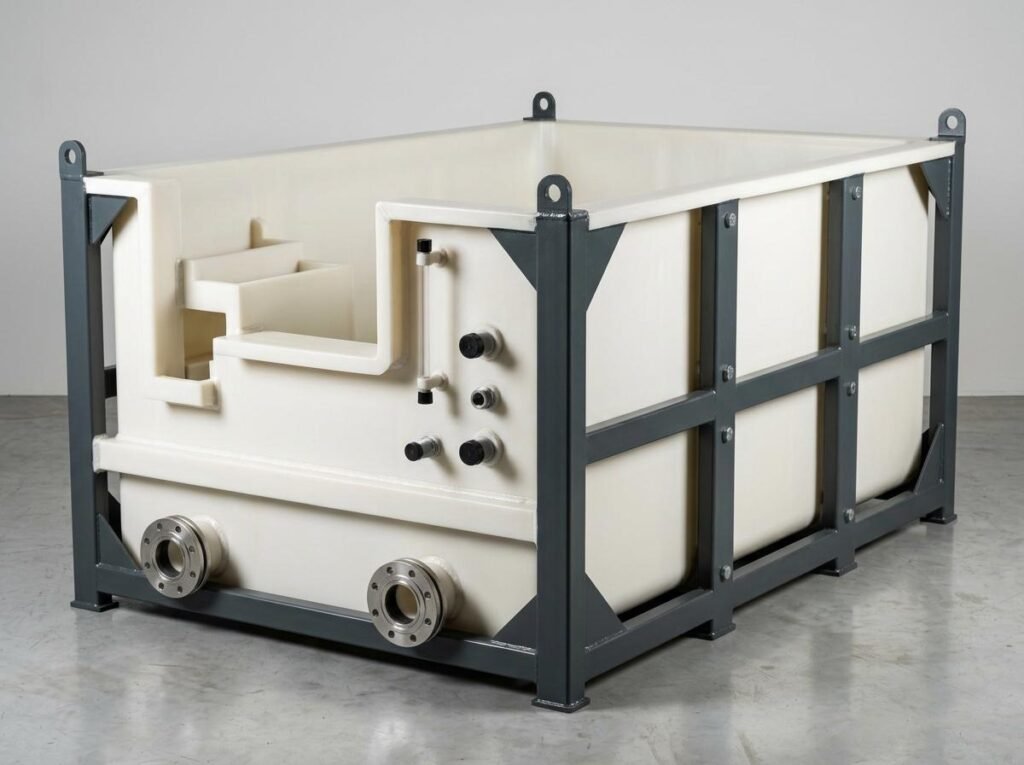
Introduction: Severe Duty Demands of Acid Pickling
Metal finishing, wire drawing, tube manufacturing, and hot-dip galvanizing plants rely on acid pickling to strip mill scale, iron rust, and surface oxides prior to processing. Operating with 15% – 20% Hydrochloric Acid (ambient) or 10% – 15% Sulfuric Acid (heated to 60°C – 75°C), pickling baths present extreme thermal, chemical, and physical impact stresses.
Material Comparison for Pickling Tanks
| Material Type | Impact Resistance | Thermal Resistance | Chemical Suitability |
|---|---|---|---|
| Fabricated Polypropylene (PP) | High ductility, absorbs bundle drop shocks | Rated up to 80°C continuous | Excellent for HCl and dilute H2SO4 |
| PP-FRP Dual Laminate | Exceptional structural rigidity | Rated up to 95°C with vinyl ester shell | Best for large volume vats (>10 meters length) |
| PVDF-FRP | Superior abrasion resistance | Rated up to 120°C continuous | Mandatory for hot nitric-hydrofluoric stainless pickling |
Preventing Heat Loss & Fume Dispersion
Modern pickling lines incorporate lip-exhaust extraction hoods connected to an FRP Acid Fume Scrubber. Retractable multi-wall insulated tank covers conserve up to 40% of bath heating energy while preventing hazardous acid vapor escape into the shop floor.
Engineering Capabilities at Nikunj Fibre Glass
We manufacture custom PP Pickling Tanks with heavy steel exterior box girder stiffening encapsulated in corrosion-proof fiberglass, ensuring zero bowing under heavy coil loading.