
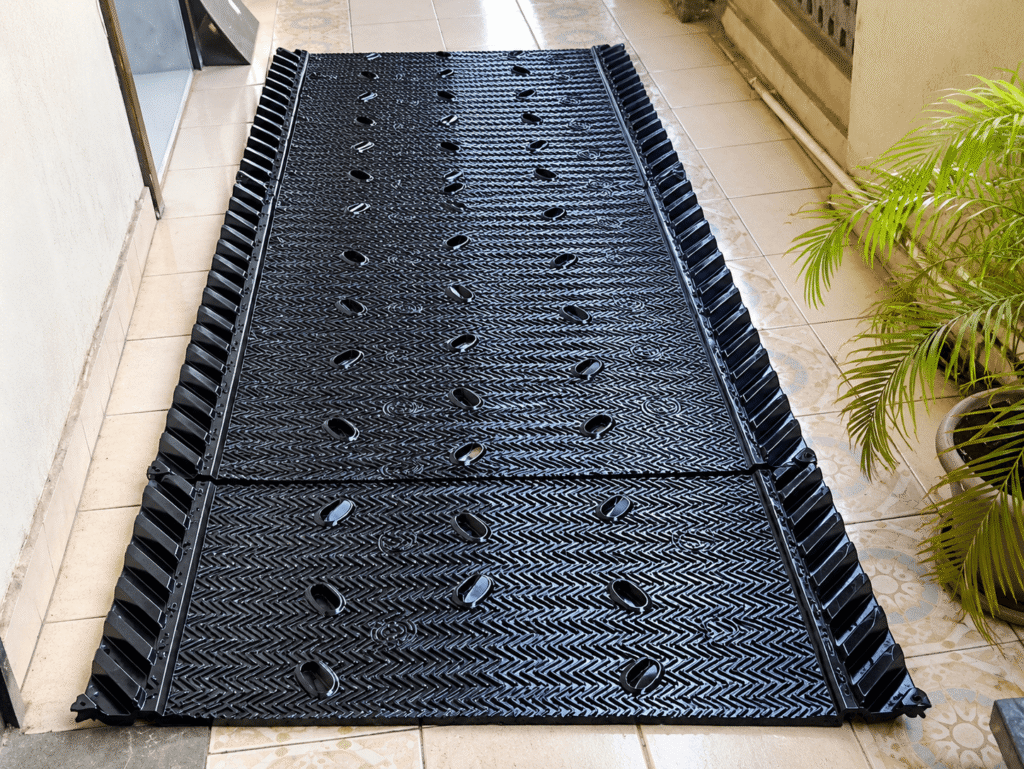
Cooling Tower Aerodynamic & Hydrodynamic Configurations
Cooling towers are classified into two fundamental airflow-water flow geometries: Counterflow (where air travels vertically upward against descending water droplets) and Crossflow (where air travels horizontally across descending water streams). The PVC fill pack geometry must be tailored to these differing flow aerodynamics to ensure optimal heat dissipation.
1. Technical Comparison: Crossflow vs. Counterflow Fills
| Parameter | Counterflow PVC Fills | Crossflow PVC Fills |
|---|---|---|
| Air-Water Contact Direction | 180° Direct opposing vertical flow | 90° Perpendicular cross-stream flow |
| Thermal Heat Transfer Rate | Maximum thermal driving force (greatest LMTD) | Slightly lower thermal driving force per m³ fill |
| Air Static Pressure Drop | Higher pressure drop; requires higher fan motor BHP | Lower pressure drop; lower fan energy consumption |
| Suspended Solids & Fouling | Higher risk of particulate settling in tight flutes | Easier water drainage; less prone to biological clogging |
| Integrated Drift Eliminators | Separate drift eliminator modules installed above sprays | Frequently molded directly into the fill sheet edge |
2. Nikunj High-Efficiency PVC Fill Features
Nikunj Fibre Glass fabricates precision thermoformed rigid PVC fills utilizing virgin-grade resin:
- Cross-fluted honeycomb matrix maximizing wetted surface area (125 to 250 m²/m³).
- Formulated with fire-retardant additives meeting ASTM E84 Class 1 flame spread rating.
- Resistant to algae, bacteria, and standard industrial water treatment biocides.
Upgrade Your Cooling Tower Efficiency
View our complete selection of Cooling Tower PVC Fills manufactured in Vapi.