
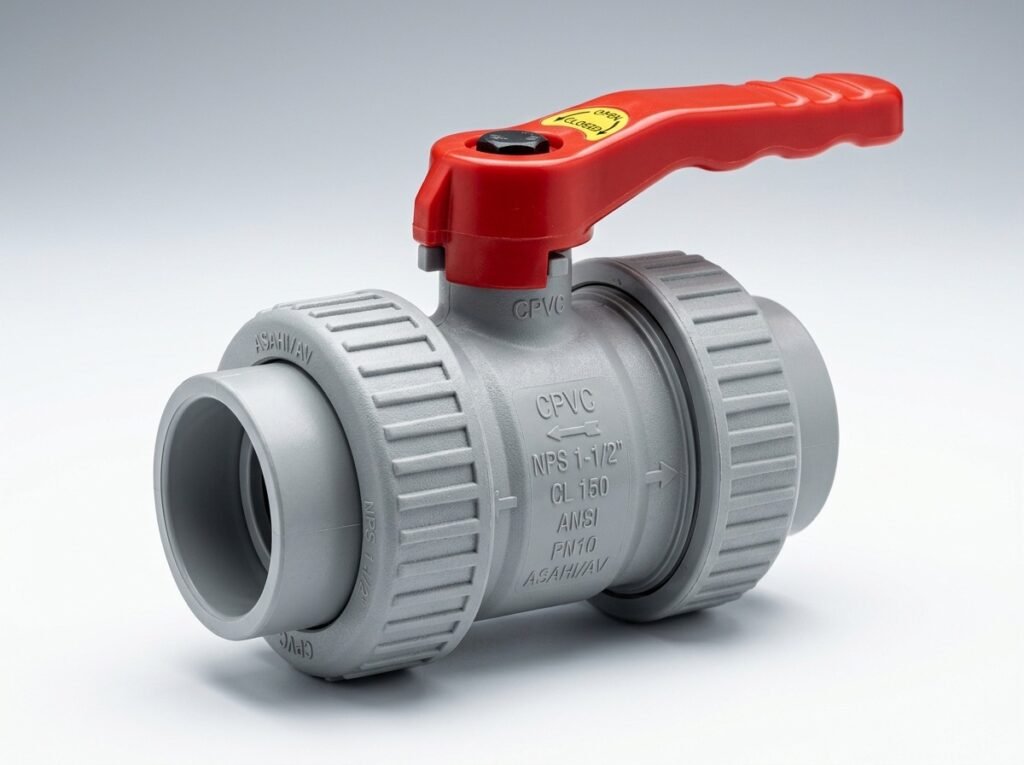
What is a True Union Ball Valve?
In standard one-piece or threaded plastic ball valves, replacing a damaged valve or repairing worn internal seals requires cutting the pipeline or uncoupling long pipe spools. A True Union Ball Valve features dual union nuts at both the inlet and outlet ports, enabling the central valve body to be completely unthreaded and slid out of the line without disturbing either side of the piping network.
1. Key Engineering Advantages in Chemical Plants
- Rapid In-Line Maintenance: The valve body can be disassembled, inspected, and re-seated in under 10 minutes, minimizing costly plant shutdown hours.
- Adjustable Seat Carrier Mechanism: Built-in spanner lugs on the valve handle allow technicians to adjust and re-tighten internal PTFE ball seat compression without opening the valve.
- Blow-Out Proof Stem Design: Internally assembled valve stems prevent stem ejection under sudden line hydraulic pressure surges.
- Bi-Directional Sealing: Functions with full rated working pressure shut-off in either fluid flow direction.
2. Material Options: PPH vs. CPVC vs. PVC-U
| Valve Body Material | Max Operating Temperature | Primary Chemical Suitability |
|---|---|---|
| PVC-U (Rigid PVC) | 60°C | Water treatment, cooling water, mild acids & alkalis |
| CPVC (Chlorinated PVC) | 90°C | Hot corrosive fluids, industrial plating, hot acids |
| PPH (Polypropylene Homopolymer) | 95°C | Aggressive organic & inorganic acids, caustic, solvents |
| PVDF (Kynar) | 140°C | Ultra-pure pharma, hot halogens, concentrated HNO3 |
Explore Nikunj Valves
Learn more about our inventory of PPH True Union Ball Valves and PVC Ball Valves.