
Why FRP Flange Assemblies Require Specialized Handling
In chemical process plants, flange connections represent the most critical leak path in piping networks. Unlike forged steel flanges which tolerate immense bolt torquing without distortion, composite FRP flanges are susceptible to bending shear and cracking if over-tightened or torqued unevenly. Adhering to engineered bolting guidelines is essential for leak-free, long-term piping integrity.
1. Dimensional Standards: ANSI B16.5 Class 150 & DIN ND 10/16
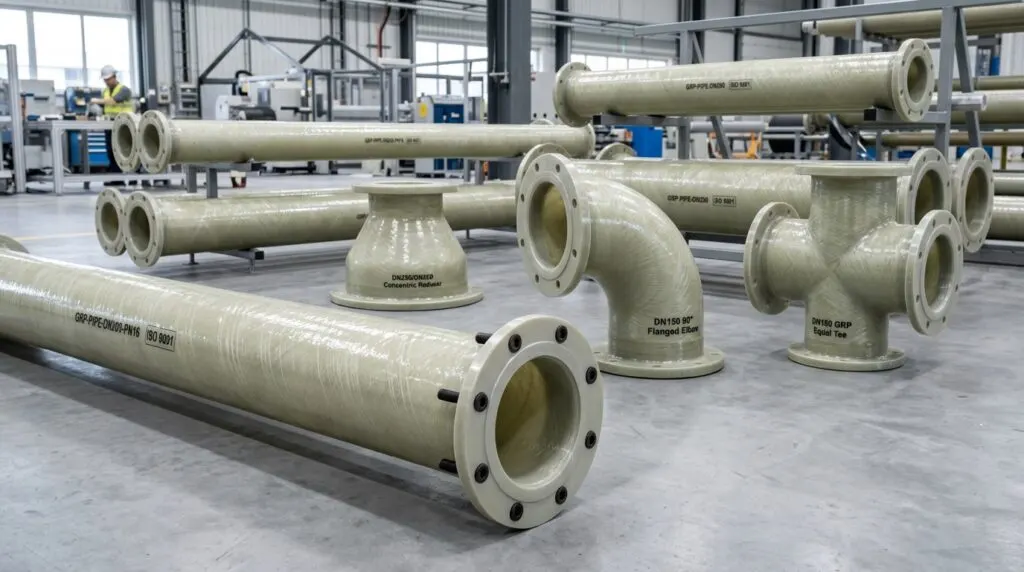
Nikunj Fibre Glass manufactures FRP flanges and stub-ends adhering to standard international bolt-hole patterns:
- ANSI B16.5 Class 150: Most prevalent standard across petrochemical, pharma, and chemical plants in India and export markets.
- Stub End with Loose Metallic Backing Ring: Allows rotational freedom for effortless bolt alignment during field installation, distributing bolting compressive force evenly.
- Full Face Integral Flanges: Fabricated with thick molded FRP hubs and tapered reinforcement gussets for heavy-duty tank nozzle connections.
2. Recommended Gasket Selection for FRP Piping
| Chemical Service | Recommended Gasket Material | Durometer Hardness (Shore A) |
|---|---|---|
| Hydrochloric Acid, Dilute Acids | Full-Face EPDM Rubber Gasket | 60 – 65 Shore A |
| Hot Concentrated Acids, Solvents | PTFE-Envelope or Expanded PTFE (ePTFE) | Low seating stress material |
| Chlor-Alkali, Bleach (NaOCl) | FKM (Viton) or Chlorobutyl | 65 – 70 Shore A |
3. Proper Bolt Torquing Procedure
Always utilize calibrated torque wrenches, wide flat washers under both bolt head and nut, and execute star-pattern torque tightening in three stages (30%, 60%, and 100% of final recommended torque values) to prevent localized flange cracking.
Discover Nikunj Piping Components
Explore our manufactured FRP Flanges and Pipe Fittings engineered for aggressive industrial environments.