
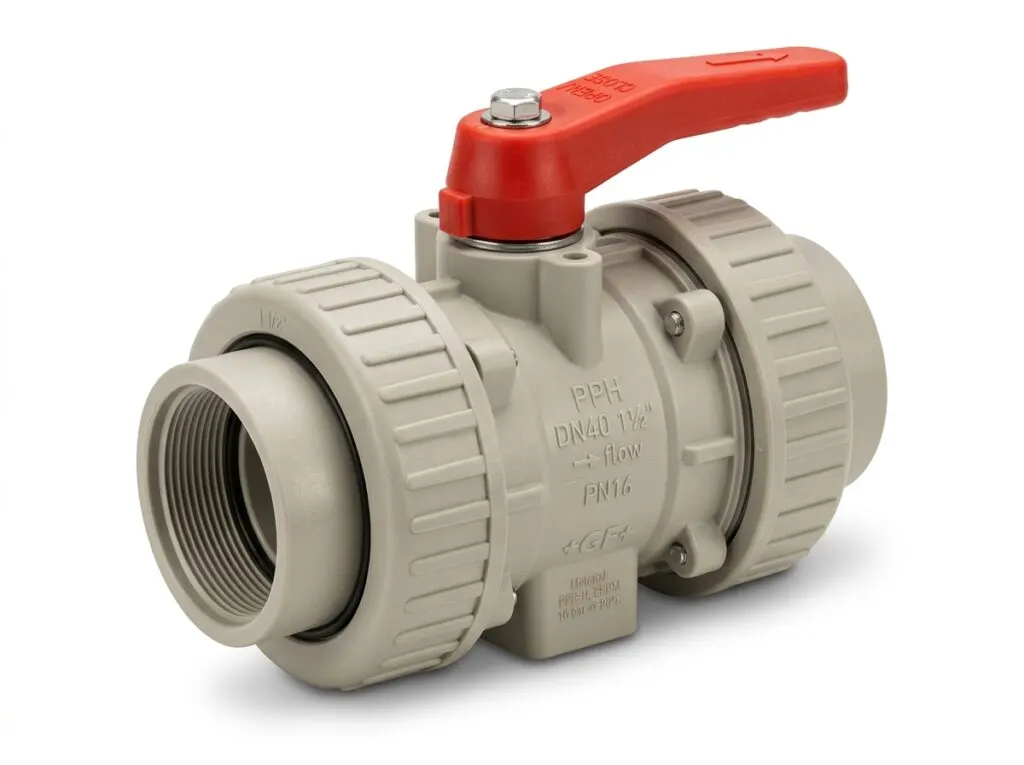
Why PPH Ball Valves Dominate Corrosive Fluid Isolation
Polypropylene Homopolymer (PPH) valves have become the preferred industrial choice over metal lined valves (such as PTFE-lined ductile iron) for aggressive acids, alkalis, and electroplating solutions up to 90°C. PPH valves provide complete external and internal corrosion immunity at a fraction of the weight and cost of lined metal valves.
1. PPH Material Characteristics & Advantages
- Chemical Inertness: Completely resistant to sulfuric acid, hydrochloric acid, sodium hydroxide (caustic soda), ferric chloride, and industrial pickling solutions.
- Homogeneous Non-Porous Body: Injection-molded high-density PPH prevents pinhole permeation and chemical cracking under continuous stress.
- True Union Design: Facilitates easy in-line valve removal and seat servicing without cutting or uncoupling the main process pipeline.
- PTFE Ball Seats & FKM/EPDM O-rings: Assures bubble-tight shut-off (Zero leakage) even after thousands of open-close operational cycles.
2. Pressure-Temperature Derating Table for PPH Valves
| Operating Temperature (°C) | Max. Working Pressure (Bar) – PN16 Valve | Max. Working Pressure (Bar) – PN10 Valve |
|---|---|---|
| 20°C | 16.0 Bar | 10.0 Bar |
| 40°C | 12.5 Bar | 8.0 Bar |
| 60°C | 9.0 Bar | 5.5 Bar |
| 80°C | 5.5 Bar | 3.5 Bar |
| 95°C | 3.0 Bar | 2.0 Bar |
Nikunj Chemical Valve Solutions
Explore our industrial range of PPH Ball Valves and PVC Ball Valves stocked in Vapi.