
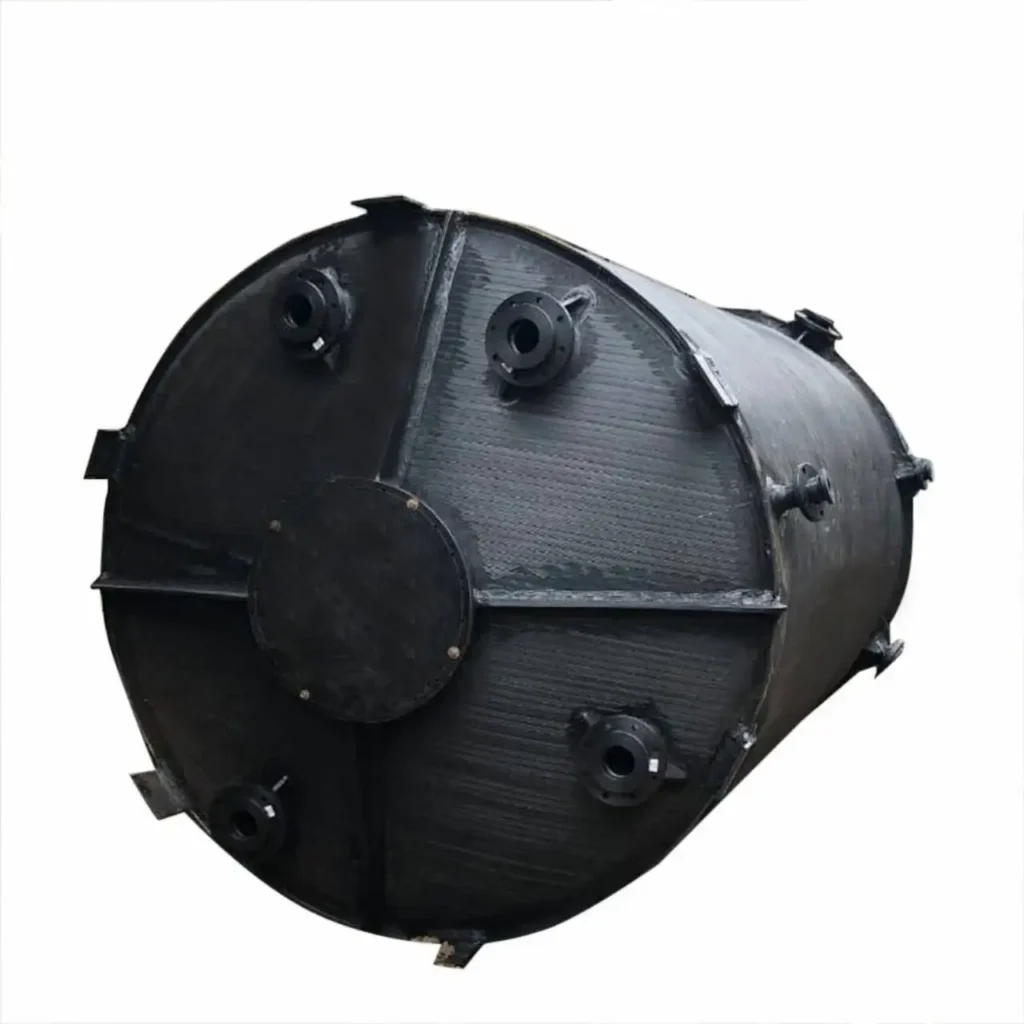
The Necessity of Hydrostatic Testing for FRP Equipment
Unlike homogeneous ductile metals, Fiberglass Reinforced Plastics (FRP) are anisotropic composite structures whose integrity relies on resin cure completeness, fiber-to-resin ratio, interlaminar bonding, and flawless nozzle fabrication. Hydrostatic testing is the definitive non-destructive proof test executed prior to commissioning chemical storage tanks, reaction vessels, and process piping.
1. Standard Testing Standards: ASTM D3299 & BS 4994
Under ASTM D3299 and BS 4994 (Clause 18), hydrostatic testing verifies structural rigidity, seam integrity, and leak-tightness under design gravity load and operational pressure:
- Atmospheric Tanks: Filled to full maximum overflow brim with ambient clean potable water and held for a minimum of 24 to 48 hours.
- Pressurized Vessels / Scrubbers: Hydrostatically pressurized to 1.3x to 1.5x design pressure using calibrated digital pressure transmitters and safety relief valves.
2. Step-by-Step Hydrostatic Inspection Procedure
- Visual Inspection Pre-Fill: Verify Barcol hardness (> 35-40), acetone rub cure test, nozzle alignment, and blind flange bolt torquing.
- Incremental Water Filling: Fill tank in 25% increments, pausing for 15 minutes at each level to check foundation settlement and structural deflection.
- 24-Hour Hold Period: Keep the vessel fully filled for 24 hours. Measure circumferential hoop expansion using dial indicators or strain gauges.
- Nozzle & Joint Seam Inspection: Thoroughly inspect all secondary lamination joints, nozzle neck gussets, manholes, and bottom knuckle joints for any dampness, weeping, or micro-cracking.
- Drainage & Internal Inspection: Drain slowly at controlled velocity to prevent vacuum collapse, followed by thorough internal inspection of the gelcoat barrier.
Commitment to Zero-Defect Manufacturing
At Nikunj Fibre Glass, 100% of manufactured FRP Vessels and FRP Pipe Assemblies undergo rigorous hydrostatic testing and third-party inspection.