
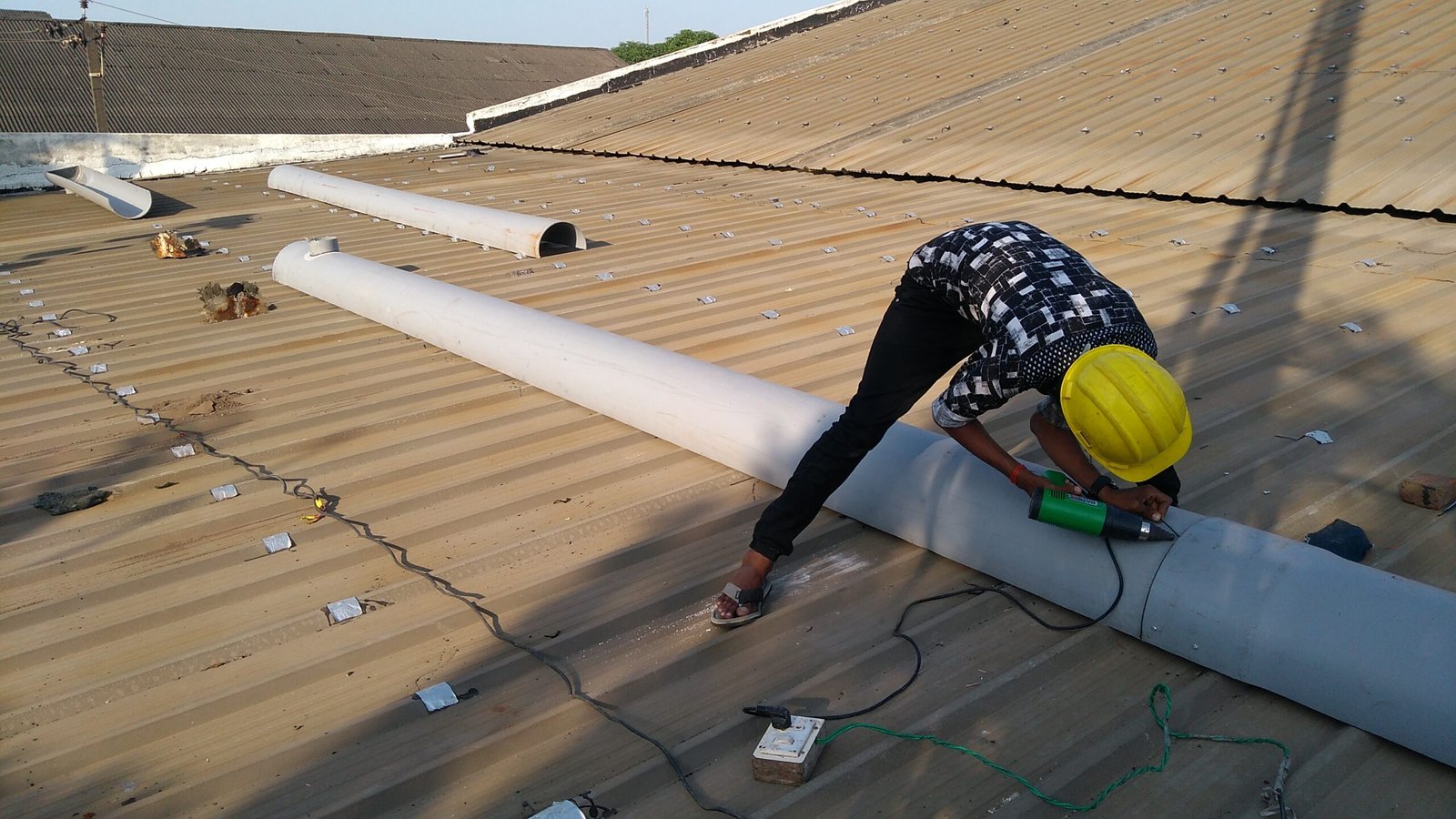
In major manufacturing and chemical corridors like Vapi, Ahmedabad, Ankleshwar, Surat, and Vadodara, industrial factory sheds and warehouse roofs are subjected to intense monsoonal deluges combined with aggressive atmospheric contaminants, acid vapours, and airborne salt. Traditionally, industrial developers relied on Galvanized Iron (GI) or pre-coated color metal gutters. However, within 18 to 24 months, metallic gutters invariably develop corrosion blisters, weld-joint failures, and rust pinholes—leading to roof perimeter water ingress, structural rot, and expensive machinery damage.
Today, engineered heavy-duty unplasticized polyvinyl chloride (uPVC / PVC) rain gutter systems have emerged as the gold standard for industrial roof drainage. In this comprehensive guide, our engineering team at Nikunj Fibre Glass breaks down the structural benefits of PVC gutters, roof hydraulic sizing calculations, and professional installation guidelines for maximum service life.
Why Industrial Sheds Are Replacing GI Gutters with PVC Gutters
Switching from traditional sheet-metal channels to precision-extruded PVC rain gutters offers immediate operational and lifecycle cost benefits:
- 100% Rust & Chemical Corrosion Resistance: Unlike galvanized iron, PVC is chemically inert. It does not react with sulfur dioxide, acidic fumes from boiler exhausts, chemical pickling plant vapors, or coastal humidity.
- Advanced UV-Stabilization: Industrial PVC gutters manufactured by Nikunj Fibre Glass incorporate high-grade titanium dioxide (TiO2) UV-inhibitors, ensuring the polymer will not embrittle, chalk, or deform under harsh Indian summer temperatures up to 60°C.
- Hydrodynamically Superior Smooth Surface: PVC channels boast an ultra-low Hazen-Williams roughness coefficient (C = 150). The frictionless interior prevents moss, dirt, and industrial soot adherence, preventing localized damming and stagnant water pooling.
- Lightweight with Minimal Dead Load: Weighing only one-fourth as much as gauge-iron gutters, PVC systems eliminate excessive strain on purlins and roof trusses while simplifying high-altitude eaves installation.
- Monolithic Joint Sealing: High-performance slip-in expansion joints equipped with durable EPDM rubber gaskets ensure watertight joint integrity while naturally absorbing diurnal thermal expansion and contraction.
Comparison: PVC Rain Gutters vs. Metal (GI) vs. FRP Gutters
| Performance Feature | Nikunj Heavy-Duty PVC Gutter | Galvanized Iron (GI) Gutter | FRP Gutter |
|---|---|---|---|
| Rust & Oxidation | 100% Rust-proof (Never corrodes) | Rusted within 2–3 years at joints | Rust-proof |
| Chemical Vapour Resistance | High (Resists acids, alkalis, salts) | Poor (Rapid galvanic corrosion) | Very High (Resin dependent) |
| Operational Lifespan | 25+ Years with zero repainting | 3 to 7 Years (Requires regular repainting) | 15 to 20 Years |
| Installation Speed | Modular snap-fit brackets (Fast) | Heavy, requires welding / riveting | Moderate (Requires joinery sealants) |
| Thermal Movement Control | Engineered EPDM expansion joints | Warping / Buckling ruptures joints | Moderate thermal stability |
| Total Cost of Ownership | Lowest (Zero maintenance cost) | High (Frequent patch repair & replacement) | Moderate to High |
Hydraulic Sizing: How to Calculate Industrial Gutter & Downpipe Capacity
Undersized gutters cause rainwater overtopping, causing water to pour backward into wall claddings or saturate perimeter soil foundations. When designing a rainwater collection layout for an industrial shed, determine the required peak run-off volume using the standard catchment formula:
Q = (C × I × A) / 360
Where:
- Q: Peak run-off rate (Liters per second, L/s)
- C: Run-off coefficient (Typically 0.90 to 0.95 for corrugated metal/FRP factory roofs)
- I: Peak local rainfall intensity (mm/hour for 15-minute storm surge, typically 120–150 mm/hr in Gujarat monsoons)
- A: Projected horizontal roof catchment area in square meters (m²)
For a standard 1,000 m² shed bay in Gujarat, run-off during heavy storm surges easily surpasses 30–38 L/s. To safely evacuate this volume without overflow:
- Install high-capacity 180 mm to 200 mm box-profile or wide half-round PVC gutters.
- Provide 110 mm or 160 mm downpipe drop outlets every 10 to 12 meters along the fascia.
- Ensure a minimum drainage slope of 1:200 (5 mm drop per meter of gutter run) toward each downpipe outlet.
Looking for Certified Heavy-Duty PVC Rain Gutters?
Nikunj Fibre Glass manufactures premium industrial-grade UV-stabilized PVC rain gutter channels, brackets, stop ends, running outlets, and downpipe connectors from our factory in Vapi GIDC, supplying throughout Gujarat and India.
Step-by-Step Installation Best Practices
- Heavy-Duty Bracket Pitching: Fasten reinforced UV-stabilized fascia brackets at maximum 600 mm intervals. In areas with high wind loading or seasonal dust deposits, reduce spacing to 500 mm.
- Expansion Allowance: PVC has a thermal linear coefficient of approximately 0.06 mm/m/°C. Always insert gutter channel ends up to the marked temperature notch within slip-in expansion joiners rather than butting them tightly edge-to-edge.
- Downpipe Drop Alignment: Align running outlets directly above downpipes and secure vertical downpipe clamps at 1.5-meter intervals to resist hydraulic vibration during heavy downpours.
- Leaf Guard Integration: Clip-on leaf and debris strainers over downpipe entries to prevent industrial airborne twigs, plastic wrappers, or bird nesting from choking vertical drains.