
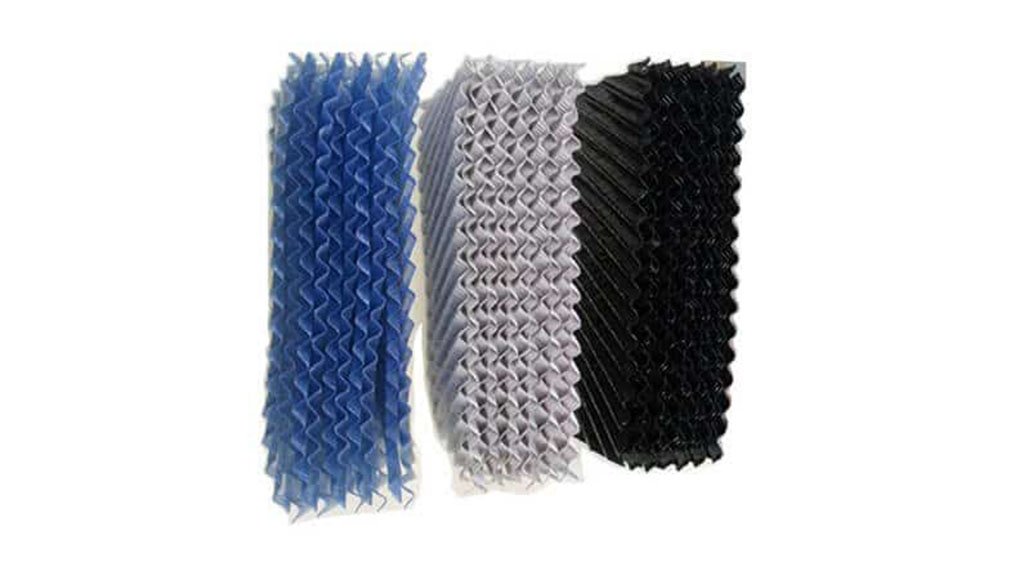
In every evaporative cooling tower, the fill media (also called cooling tower packing or honeycomb fill) represents the core heat-exchange matrix. The fill’s job is straightforward yet critical: distribute descending hot process water into an ultra-thin liquid film across an expansive surface area while ascending air strips away heat through latent evaporation. However, selecting the incorrect fill material or misjudging water return temperatures leads to catastrophic consequences—plastic softening, structural flute collapse, fan motor overload, and surging process water temperatures.
Two primary thermoformed polymer materials dominate Indian industrial cooling tower installations: Polyvinyl Chloride (PVC) and Acrylonitrile Butadiene Styrene (ABS). In this engineering analysis, Nikunj Fibre Glass compares the thermal thresholds, aerodynamic profiles, and mechanical lifespans of PVC fills and ABS Sigma fills to help plant engineers make the optimal procurement decision.
Thermal Operating Limits: The Defining Difference
The single most critical criterion when selecting cooling tower fill media is the maximum continuous hot water return temperature from heat exchangers, chillers, or condenser loops:
1. Standard PVC Cooling Tower Fills (Continuous Rating: Up to 55°C)
Polyvinyl Chloride is the industry workhorse for moderate-temperature cooling circuits. High-grade PVC delivers excellent flame retardancy (self-extinguishing rating), high wettability, and exceptional cost efficiency. However, PVC possesses a heat deflection temperature of approximately 58°C to 60°C.
Warning: If continuous process return water exceeds 55°C, PVC sheets begin to undergo thermoplastic creep. Flutes sag, the corrugated air pathways collapse inward, and static air pressure skyrockets, causing fan motor tripping and permanent loss of cooling capacity.
2. ABS Sigma Fills (Continuous Rating: Up to 85°C–90°C)
Acrylonitrile Butadiene Styrene (ABS) is a high-performance terpolymer engineered specifically for high thermal and mechanical stress environments. ABS features superior heat resistance, with continuous operating capabilities up to 85°C (and short-term temperature surges up to 90°C) without any dimensional alteration or flute deformation.
Additionally, ABS possesses more than double the Izod impact strength of standard PVC, preventing brittleness and sheet shattering even in chemically harsh process water containing traces of ammonia, oils, or organic solvents.
Engineering Comparison: PVC Fills vs. ABS Sigma Fills
| Technical Parameter | Standard PVC Fills | ABS Sigma Fills |
|---|---|---|
| Max Continuous Hot Water Temp | 55°C (131°F) | 85°C (185°F) |
| Peak Surge Water Temp | 60°C | 90°C–95°C |
| Standard Pack Dimensions | 600 mm × 300 mm × 150 mm | 600 mm × 300 mm × 150 mm |
| Flute Geometry Options | 12 mm / 19 mm Cross-flute | Advanced Sigma-wave & Cross-flute |
| Mechanical Impact Strength | Moderate (Prone to aging brittleness) | Very High (Resists ice, sludge & impact) |
| Edge Reinforcement | Edge-folded technology | Edge-folded / Solid monolithic border |
| Chemical & Oil Resistance | Good for general water loops | Superior for hydrocarbon & solvent traces |
| Common Industrial Uses | HVAC chillers, DG sets, plastic molding | Steel rolling mills, induction furnaces, distilleries |
The Power of Edge-Folded Technology in PVC Fills
One common failure mode in lower-grade cooling tower fills is leading-edge tearing. High-velocity water droplets discharged from overhead spray nozzles constantly pummel the top face of the fill pack. Over time, raw cut plastic edges fray, tear, and break into fragments that clog basin strainers and circulating pump impellers.
To combat this, Nikunj Fibre Glass incorporates Edge-Folded Technology. The leading and trailing borders of each thermoformed sheet are doubled over into a rigid reinforced lip. This double-thickness border:
- Increases structural bearing capacity by more than 300%, allowing technicians to walk on installed pack decks during maintenance (with crawling boards).
- Eliminates edge attrition and micro-plastic fragment migration into heat exchanger tubes.
- Maintains consistent air inlet aerodynamic velocity, preventing turbulent pressure drop spikes.
Upgrade Your Tower Performance with High-Temp Fills
Nikunj Fibre Glass manufactures virgin PVC cooling tower fills, high-temperature ABS fills, and advanced ABS Sigma packs in standard 600×300×150 mm blocks and custom cut-to-fit sizes with edge-folded reinforcement.
Industry Selection Matrix: Which Fill Does Your Facility Need?
- Choose PVC Fills for: Centralized HVAC chiller plants, plastic injection molding cooling, refrigeration condensers, captive power generation units operating below 50°C return water, and commercial shopping mall cooling towers.
- Choose ABS Sigma Fills for: Induction melting furnaces, steel reheating and rolling lines, chemical reaction jacket cooling, sugar mills and distilleries, forging facilities, and high-fouling recirculating wastewater streams where temperatures routinely spike above 60°C.