
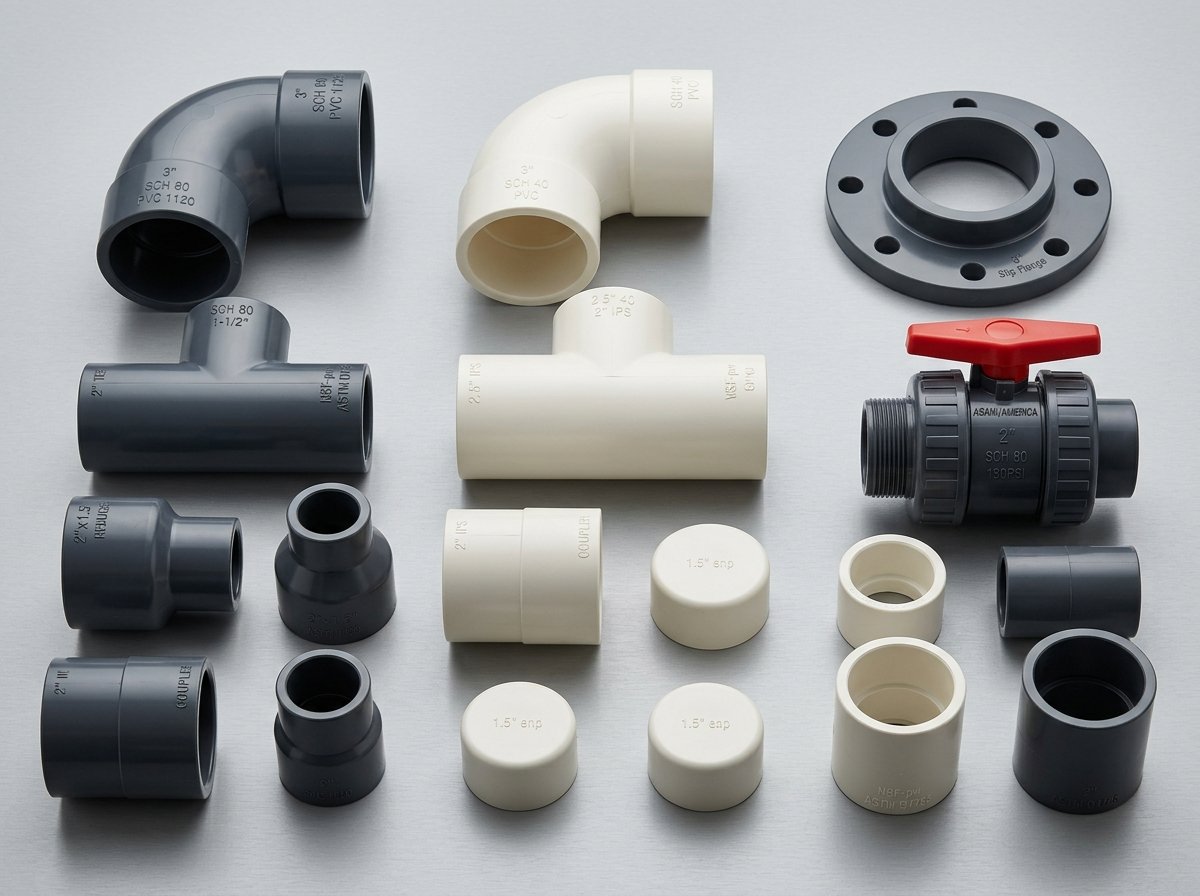
In chemical processing factories, pharmaceutical manufacturing, effluent treatment plants (ETP), and industrial water utilities, selecting the right piping schedule is a critical engineering decision. Unplasticized Polyvinyl Chloride (uPVC / PVC) has long been favored for its remarkable resistance to inorganic acids, alkalis, salts, and corrosive fluids. However, piping failures, joint blowout leaks, and water hammer damage frequently occur when engineers fail to distinguish between Schedule 40 (SCH 40) and Schedule 80 (SCH 80) PVC pipe fittings.
In this technical guide, Nikunj Fibre Glass provides a detailed comparison of wall thicknesses, hydrostatic working pressure ratings, application scopes, and the 5-step professional solvent cementing method required for 100% leak-proof industrial installations.
The Fundamental Engineering Difference: Wall Thickness
The primary distinction between Schedule 40 and Schedule 80 fittings lies in their wall thickness:
- Standard Outer Diameter (OD): Both Schedule 40 and Schedule 80 pipes share the exact same outer diameter for a given nominal pipe size (NPS). For instance, a 2-inch SCH 40 pipe and a 2-inch SCH 80 pipe both measure exactly 2.375 inches (60.3 mm) in outer diameter.
- Thicker Wall in Schedule 80: Schedule 80 fittings feature a significantly thicker cross-sectional wall. Because the outer diameter is fixed, this extra material extends inward, reducing the inner diameter (ID) slightly while substantially increasing the burst strength and hoop stress resistance.
- Color Coding Convention: In industrial practice, Schedule 40 fittings are conventionally molded in white or light grey, whereas heavy-duty Schedule 80 fittings are molded in dark grey polymer.
Pressure Ratings and Hydrostatic Performance
Because industrial lines frequently handle pressurized chemical transfer, cooling water loops, and pump discharge surges, pressure capability is paramount:
| Nominal Size (NPS) | Schedule 40 Working Pressure (at 23°C) | Schedule 80 Working Pressure (at 23°C) | Wall Thickness Ratio (SCH 80 vs SCH 40) |
|---|---|---|---|
| 1/2 Inch (15 mm) | 600 PSI (41.4 bar) | 850 PSI (58.6 bar) | +36% Thicker |
| 1 Inch (25 mm) | 450 PSI (31.0 bar) | 630 PSI (43.4 bar) | +37% Thicker |
| 2 Inch (50 mm) | 280 PSI (19.3 bar) | 400 PSI (27.6 bar) | +42% Thicker |
| 3 Inch (80 mm) | 260 PSI (17.9 bar) | 370 PSI (25.5 bar) | +40% Thicker |
| 4 Inch (100 mm) | 220 PSI (15.2 bar) | 320 PSI (22.1 bar) | +43% Thicker |
| 6 Inch (150 mm) | 180 PSI (12.4 bar) | 280 PSI (19.3 bar) | +54% Thicker |
Temperature Derating Notice: PVC pressure ratings are benchmarked at 23°C (73°F). As operating temperatures rise toward the material’s maximum limit of 60°C (140°F), pressure ratings must be derated by up to 78%. At 50°C, a Schedule 80 line is essential to maintain safety margins that would otherwise exceed Schedule 40 capabilities.
Industrial Application Matrix: When to Specify SCH 40 vs. SCH 80
Specify Schedule 40 PVC Fittings for:
- Gravity-fed wastewater and effluent drainage headers.
- Low-pressure RO permeate and demineralized water distribution loops (< 100 PSI).
- Rainwater collection downpipes and warehouse roof drainage connections.
- Light irrigation and municipal landscape water loops.
Specify Schedule 80 PVC Fittings for:
- Pressurized chemical dosing lines (Dilute hydrochloric acid, sodium hypochlorite, caustic soda, ferric chloride).
- Cooling tower pump discharge and recirculating headers subject to water hammer.
- Demanding chemical process lines in pharmaceutical, dye, and fertilizer manufacturing plants.
- Underground buried high-pressure utility lines subject to soil backfill loading.
Heavy-Duty Industrial PVC Pipe Fittings from Nikunj Fibre Glass
We manufacture and supply precision-engineered industrial PVC pipe fittings across Gujarat and India: 90°/45° elbows, equal/reducing tees, concentric reducers, sockets, end caps, and flanged connections with EPDM/Neoprene gaskets.
5-Step Professional Solvent Welding Guide for Leak-Proof Joints
More than 90% of industrial PVC piping failures occur at improperly bonded socket joints. Unlike glue, PVC solvent cement does not act as an adhesive; it chemically dissolves the polymer chains on both surfaces, fusing them into a monolithic, homogenous weld. Follow this 5-step procedure:
- Square Cut & Chamfer: Cut the pipe square using a fine-toothed saw or rotary cutter. Always bevel the outer pipe edge with a 15° chamfer to prevent scraping solvent cement off the socket interior during insertion.
- Deburr and Dry Fit: Remove all internal and external burrs. Check dry fit; the pipe should easily slip one-third to two-thirds into the socket fitting before snugging up.
- Apply Industrial Primer / Cleaner: Generously apply purple or clear PVC primer to the inside of the fitting socket and the outside of the pipe end. Primer chemically softens the rigid polymer surface glaze to prepare it for bonding.
- Apply Heavy-Duty Solvent Cement: While the primer is still wet, apply an even, medium layer of cement to the fitting socket and a full, generous layer to the pipe end. Work swiftly within 20–30 seconds.
- Insert, Quarter-Turn Twist & Hold: Immediately push the pipe into the fitting socket until it hits the shoulder stop, giving it a 90° (quarter-turn) twist during insertion to ensure full circumference cement distribution. Hold firmly for 30 seconds to prevent joint push-out. Wipe away excess cement bead and allow full cure (minimum 24 hours before hydrostatic pressure testing).